
Sri Aurobindo (1872 – 1950) was a key figure in the early movement for Indian Independence. He was arrested by the British on charges of sedition and after a deep spiritual experience in jail, he left politics to pursue a path of spiritual seeking. Sri Aurobindo founded an ashram in Pondicherry, where he became a prominent spiritual philosopher, poet and Spiritual Master. His greatest work was the epic poem Savitri and his Magnus opus The Life Divine.
Short Biography Sri Aurobindo
Aurobindo Ghose was born in India on 15th August 1872. At a young age, he was 
Upon graduating he decided to return to India where he took up a position as a teacher. It was also on returning to India that Aurobindo recounts his first most significant spiritual experience. He relates on how returning to Indian soil he was inundated with a profound peace. This experience came unsought but at the same time, he continued to become more deeply connected with the Indian independence movement. Aurobindo was one of the first Indian leaders to openly call for complete Indian independence; at the time, the Indian Congress wanted only partial independence. In 1908 Aurobindo was implicated in the Alipore bomb plot in which two people died. As a consequence, Aurobindo was jailed whilst awaiting trial.
In prison, Aurobindo underwent a profound and life-changing spiritual experience. He began to meditate very deeply and inwardly received spiritual instruction from Swami Vivekananda and Sri Krishna. From the depths of the British prison, Aurobindo saw that Brahmin or God pervaded the entire world. There was nothing that was separated from the existence of God. Even in the worst criminal, Aurobindo saw at heart – God or Vasudev.
During his spiritual transformation, Sri Aurobindo received an inner command to give up politics and devote his life to spirituality and the descent of a new spiritual consciousness. He also received an inner guarantee that he would be fully acquitted in his forthcoming trial. Due to the tireless efforts of C.R.Das, Aurobindo was acquitted and was free to leave. However, the British were still very suspicious, and so Aurobindo decided to move to the French province of Pondicherry where he began to practise meditation and spiritual disciplines. In Pondicherry, he also began to attract a small group of spiritual seekers who wished to follow Sri Aurobindo as a Guru. A couple of years later, a French mystic by the name of Mirra Richards (b. Alfassa) came to visit Pondicherry. Sri Aurobindo saw in her a kindred spirit. Later he would say himself and the Mother (Mirra Richards) were one soul in two bodies. After the Mother settled in the ashram in 1920, the organisation of the Ashram was left in her hands whilst Sri Aurobindo increasingly retreated to give him more time for meditation and writing.
Sri Aurobindo was a prolific writer writing some of the most detailed and comprehensive discourses on spiritual evolution. Sri Aurobindo said that his inspiration to write came from his inner pilot, from a higher source. Sri Aurobindo wrote extensively, in particular, he spent many hours patiently replying to the questions and problems of his disciples. Even on the smallest detail, Sri Aurobindo would reply with great care, attention and often good humour. It is interesting to note that Sri Aurobindo often refused to write for prestigious newspapers and journals, he frequently turned down requests to return to the leadership of the Indian independence movement. Sri Aurobindo was also a Seer Poet of the highest order. His epic Savitri is a testimony to his own spiritual sadhana. For over 20 years he continually refined and amended this mantric poetic output. It became one of the most powerful testimonies of his spiritual consciousness.
“A burning Love from white spiritual founts
Annulled the sorrow of the ignorant depths;
Suffering was lost in her immortal smile.
A Life from beyond grew conqueror here of death;
To err no more was natural to mind;
Wrong could not come where all was light and love.”
From: The adoration of the Divine Mother, Savitri
After moving to Pondicherry, Sri Aurobindo rarely made any public announcements. However, on rare occasions, he did break his silence.
In 1939, Sri Aurobindo publically states his support for the British war effort against Hitler’s Nazi Germany. This was a surprise given his opposition to British rule in India, but Aurobindo frequently warned of the stark dangers of Hitler’s Germany.
“Hitlerism is the greatest menace that the world has ever met – if Hitler wins, do they think India has any chance of being free? It is a well-known fact that Hitler has an eye on India. He is openly talking of world-empire…” (May 17, 1940)
In 1942, when the British made an offer of Dominion status to India in 1942 in return for full co-operation during the war, Aurobindo wrote to Gandhi, advising him to accept. But, Gandhi and Congress rejected his advice. Aurobindo wrote to Sir Stafford Cripps
“As one who has been a nationalist leader and worker for India’s independence, though now my activity is no longer in the political but in the spiritual field, I wish to express my appreciation of all you have done to bring about this offer. I welcome it as an opportunity given to India to determine for herself, and organise in all liberty of choice, her freedom and unity, and take an effective place among the world’s free nations. I hope that it will be accepted, and right use made of it, putting aside all discords and divisions…. I offer my public adhesion, in case it can be of any help in your work”. (source)
Apart from these rare forays in public comment, Sri Aurobindo concentrated on his inner work and writings. In November 1938, Sri Aurobindo broke his leg and retreated, even more, seeing only a small number of close disciples. However, he kept his written correspondence with them. Aurobindo felt his real calling was to bring down a spiritual consciousness. He expressed his spiritual philosophy
“The one aim of [my] yoga is an inner self-development by which each one who follows it can in time discover the One Self in all and evolve a higher consciousness than the mental, a spiritual and supramental consciousness which will transform and divinize human nature.”
Sri Aurobindo once wrote that it is impossible to write a biography of a spiritual Master because so much of their life happens on the inner plane and not outer plane.
India achieved its independence on 15 August 1947. Sri Aurobindo remarked on this event.
‘August 15, 1947 is the birthday of free India. It marks for her the end of an old era, the beginning of a new age, but we can also make it by our own life and acts as a free nation, an important date in a new age opening to the whole world for the political, social, cultural and spiritual future of humanity. August 15 is my own birthday and it is naturally gratifying to me that it should have assumed this vast difference. I take this coincidence not as a fortuitous accident, but as the sanction and seal of the divine force that guides my steps on the work with which I began life, the beginning of its full fruition. Indeed on this day, he says, I can watch almost all the world movements which I hope to see fulfilled in my lifetime; though then they looked like impracticable dreams arriving at fruition or on their way to achievement. In all these movements, free India may well play a large part and take a leading position.’
On 5 December 1950, at the age of 78, Sri Aurobindo left his physical body. He had recently said that he could continue his spiritual work from the soul’s world.
Citation: Pettinger, Tejvan. “Biography of Sri Aurobindo”, Oxford, UK – biographyonline.net. Published 3rd August 2009. Last updated 19 February 2018.
How did Sri Aurobindo change the world?
Sri Aurobindo life had two very distinct phases. The political and the spiritual. After returning to India, Aurobindo was a foremost leader of the Indian revolutionary movement. Preferring to work out of the limelight, he was still a powerful force in raising Indian aspirations to work for complete independence from the British. Aurobindo’s activism came at a critical time when he supported and encouraged the new, radical voices which sought complete independence.
However, Aurobindo’s greatest combination was still to come – as a mystic, philosopher, poet and spiritual Master. At the height of the First World War, Aurobindo published his philosophic opus The Life Divine, explaining his philosopher of spiritual evolution and the hope to transform human nature into the divine.
The philosophy of Sri Aurobindo was a break with much of Indian spirituality. Sri Aurobindo did not believe in just retreating from the world, and seeking to gain an inner enlightenment, he felt mysticism was only a partial goal. He also sought the transformation of human nature and the divinisation of life on earth. Sri Aurobindo developed a philosophy of ‘integral yoga’ – a yoga that encompassed all aspects of life and sought to bring spirituality and light into all matter.
“The spiritual life, on the contrary, proceeds directly by a change of consciousness, a change from the ordinary consciousness, ignorant and separated from its true self and from God, to a greater consciousness in which one finds one’s true being and comes first into direct and living contact and then into union with the Divine. For the spiritual seeker this change of consciousness is the one thing he seeks and nothing else matters.”
― Sri Letters on Yoga, Vol 1
At the outbreak of the Second World War, Aurobindo again showed his complete independence of mind and spirit. Surprising many of his countrymen, he wholeheartedly supported the British War effort, seeing in Hitler – dark asuric forces, which, should they win, would hold back the world’s spiritual evolution for centuries.
Sri Aurobindo once said that it is not possible to write the biography of a spiritual Master because their real work is on the inner planes, not immediately observable. In conversations with disciples during World War II, Sri Aurobindo hinted it was after Dunkirk where he began offering his inner will and inner support for the cause of the Allies.
On his birthday – 15 August 1947, India received her full independence from Britain. Aurobindo took this as a sign of the divine providence that had offered him the assurance Indian independence would be achieved.
Sri Aurobindo’s Integral Yoga
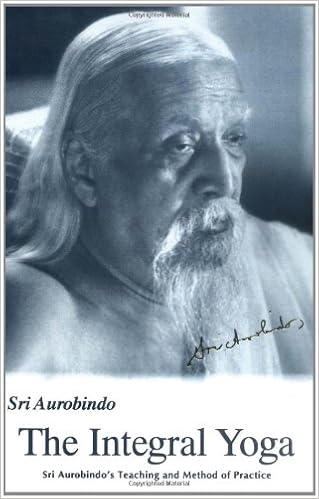
Sri Aurobindo’s Yoga at Amazon
Related pages
 Famous Indians – A list of Indian men and women throughout the ages. Categories include politicians, scientists, sports people, spiritual figures and cultural figures. Includes Mahatma Gandhi, Akbar, Swami Vivekananda and Indira Gandhi.
 Spiritual figures – Famous saints, mystics and religious figures. Including Jesus Christ, The Buddha, Lord Krishna, St Teresa of Avila.
