
Otto Hahn (1879-1968) was a German Chemist, who was awarded the Nobel Prize for Chemistry in 1944 – for his work in discovering Nuclear Fission. He was a distinguished Chemist who worked in the pioneering fields of radiochemistry. After the Second World War, he was a campaigner against the use of nuclear weapons and became an influential scientific figure in West Germany.
Short Biography Otto Hahn

He went to the University College, London and worked under Sir William Ramsay. Hahn hoped to improve his knowledge of chemistry and English to help his professional career. In early 1906, he visited Montreal, where he spent a brief but fruitful time with Ernest Rutherford, where they investigated alpha-rays of radioactinium.
In 1906, he returned to Germany where he collaborated with Emil Fischer at the University of Berlin. With just a basic chemistry laboratory, Hahn discovered Meothorium, and the mother substance of radium, ionium. This discovery later had a great practical use for radiation treatment.
In 1907, he began a long working relationship with the Jewish Austrian physicist, Lise Meitner. They remained life-long friends though she later criticised him for not doing enough to oppose the Nazi regime and their persecution of Jews. Though Hahn did help a few Jewish scientists escape and played a role in helping Meitner herself to escape to Sweden in 1938 after the Anschluss forced her to flee.
In 1910, he was appointed professor at the Kaiser Wilhelm Institute for Chemistry, where he became head of the radiochemistry department.
During the First World War, Hahn was conscripted into the German army and put to work on developing chemical warfare. He participated in developing and organising the use of poison gases, such as Chlorine and Mustard Gas on both the Western and Eastern fronts.
After the war, Hahn concentrated on the chemistry of radioactive elements. In 1921, with Lise Meitner, they made a very important discovery of Uranium Z – the first example of nuclear isomers. Although few paid much attention, this would prove very important in later nuclear physics.In 1936, he produced a book “Applied Radiochemistry” which became a very significant milestone in radiochemistry. Glenn Seaborg said:
“I believe that it is fair to refer to Otto Hahn as the father of radiochemistry and of its more recent offspring nuclear chemistry.”
In the late 1930s, the Hahn group made more progress on the study of Uranium and were the first scientists to measure the half-life of Uranium. By 1939, the Hahn group had discovered the basic mathematics of nuclear fission and the fact that the uranium nuclei split when bombarded with atoms. However, they didn’t continue their work to its conclusion of producing the atomic bomb.
During the Second World war, Hahn and Fritz Strassmann continued to work on nuclear physics. At the end of World War II, he was interned in England on suspicion of working on the Germany nuclear programme. He was released in 1946.
Hahn and Strassmann were able to discover nuclear fission by exceptionally good chemistry, fantastically good chemistry, which was way ahead of what anyone else was capable of at that time. The Americans learned it to do later. But at that time, in 1938, Hahn and Strassmann were really the only ones who could do it, because they were such good chemists.
- Prof. Dr Lise Meitner in an interview with the German television, ARD, March 8, 1959.
During his time of internment, he was awarded the 1944 Nobel Prize for Chemistry ‘for his discovery of the fission of heavy atomic nuclei’ He was unable to attend because of his internment in England. Some scientists have argued his colleague Meitner should have been awarded the prize jointly.
Hahn was shocked to learn that the atomic bomb had been dropped on Japan in 1945, to devastating effect. He felt guilty that he, in some way, may have been responsible for this great loss of life.
After the Second World War, he campaigned against the use of Nuclear weapons, and in 1955 initiated the Mainau Declaration which warned of the dangers of atomic weapons. He became a leading figure within post-war FDR and was a high profile critic of rearming West Germany with atomic weapons. His opposition to the nuclear arms race caused him to be nominated for the Nobel Peace Prize.
In 1966, he was awarded the Enrico Fermi Prize – the only time it has been awarded to a non-American.
Between 1948 to 1960, Hahn was the founding President of the Max Planck Society for the advancement of science. Otto Hahn died in West Germany on 28th July 1968.
Time Magazine, wrote this tribute:
In postwar Germany, Otto Hahn became the most revered elder statesman of what had once been Europe’s proudest scientific establishment. He collected many awards, including a Nobelprize in Chemistry for his discovery of fission. But he always accepted such honours with characteristic humility. Visiting an atomic reactor or nuclear power station, he would shrug modestly: ‘It has all been the work of others.’ In a soon-to-be-published 300-page memoir, he brushed off his historic working in fewer than five pages. Last week, at he age of 89, the father of fission died peacefully in his beloved Göttingen.
- TIME Magazine, New York, August 9th, 1968.
Citation: Pettinger, Tejvan. “Biography of Otto Hahn”, Oxford, UK – biographyonline.net. Last updated 17th March 2013.
Otto Hahn and the Story of Nuclear Fission
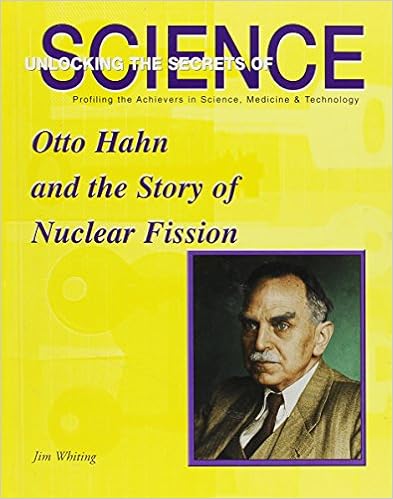
Otto Hahn and the Story of Nuclear Fission at Amazon
Main discoveries
- Discovery of radioactive elements (1905–1921)
- Radioactive recoil (1909)
- Fajans-Paneth-Hahn Law
- Protactinium (1917)
- Nuclear isomerism (1921)
- Applied Radiochemistry (1936)
- Nuclear fission (1938)
Related pages
 Scientists – Famous scientists from Aristotle and Archimedes to Albert Einstein and Charles Darwin. Including mathematicians, biologists, physicists and chemists.
Famous Germans

