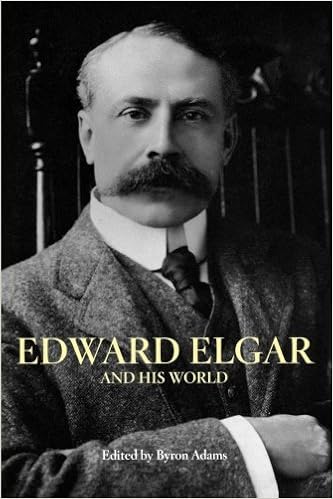
Edward Elgar Biography
Edward Elgar was born in the small village of Lower Broadheath outside Worcester, England to William Elgar, a music dealer, and his wife Anne (née Greening).Edward Elgar was born in the small village of Lower Broadheath outside Worcester, England to William Elgar, a music dealer, and his wife Anne (née Greening). Elgar was the fourth of their seven children
Elgar was an early riser, and would often turn to reading Voltaire, Drayton historical classics, Longfellow and other works encouraged by his mother. By the age of eight, he was taking piano and violin lessons, and would often listen to his father playing the organ at St. George's church, and soon also took it up. His prime interest, however, was the violin, and his first written music was for that instrument.
Surrounded by sheet music, instruments, and music textbooks in his father's shop in Worcester's High Street, the young Elgar became self-taught in music theory. On warm summer days, he would take manuscripts into the countryside to study them (he was a passionate and adventurous early cyclist from the age of 5). Thus there began for him a strong association between music and nature. As he was later to say, "There is music in the air, music all around us, the world is full of it and you simply take as much as you require."
At the age of 15, Elgar had hoped to go to Leipzig, Germany to study music, but lacking the funds he instead left school and began working for a local solicitor. Around this time he made his first public appearances as a violinist and organist. After a few months, he left the solicitor and embarked on a musical career, giving piano and violin lessons, and working occasionally in his father's shop. Elgar was an active member of the Worcester Glee Club, along with his father, and he accompanied singers, played violin, composed and arranged works, and even conducted for the first time. At 22 he took up the post of bandmaster at the Worcester and County Lunatic Asylum in Powick, three miles south-west of Worcester, a progressive institution which believed in the recuperative powers of music. He composed here too; some of the pieces for the asylum orchestra (music in dance forms) were rediscovered and performed locally in 1996.
In many ways, his years as a young Worcestershire violinist were his happiest. He played in the first violins at the Worcester and Birmingham Festivals, and one great experience was to play Antonín Dvo?ák's Symphony No. 6 and Stabat Mater under the composer's baton. As part of a wind quintet and for his musical friends, he arranged dozens of pieces by Mozart, Beethoven, Haydn, and other masters, honing his arranging and compositional skills, and applying them to his earliest pieces. Although somewhat solitary and introspective by nature, Elgar thrived in Worcester's musical circles.
Elgar's Salut d'Amour is one of his most well-known works.
In his first trips abroad in 1880-82, Elgar visited Paris and Leipzig, attended concerts by first rate orchestras, and was exposed to the music of Richard Wagner, an immensely popular musician of the time. Returning to his more provincial milieu increased his desire for a wider fame. He often went to London in an attempt to get his works published, but this period in his life found him frequently despondent and low on money. He wrote to a friend in April 1884, "My prospects are about as hopeless as ever ... I am not wanting in energy I think, so sometimes I conclude that 'tis want of ability...I have no money--not a cent."
At 29, through his teaching, he met (Caroline) Alice Roberts, daughter of the late Major-General Sir Henry Roberts and a published author of verse and prose fiction. Eight years older than Elgar, she became his wife three years later, against the wishes of her family. They were married on 8 May 1889, at Brompton Oratory. Alice's faith in him and her courage in marrying 'beneath her class' were strongly supportive to his career. She dealt with his mood swings and was a generous musical critic. She was also his business manager and social secretary. She did her best to gain him the attention of influential society, though with limited success. In time he would learn to accept the honours given him, realizing that they mattered more to her and her social class. She also gave up some of her personal aspirations to further his career. In her diary she later admitted, "The care of a genius is enough of a life work for any woman." As an engagement present, Elgar presented her with the short violin and piano piece Salut d'Amour. With Alice's encouragement, the Elgars moved to London to be closer to the centre of British musical life, and Edward started composing in earnest. The stay was unsuccessful, however, and they were obliged to return to Great Malvern, where Edward could earn a living teaching and conducting local musical ensembles. Though disappointed at the London episode, the return to the country proved better for Elgar's health and as a base of musical inspiration, bringing him closer to nature and to his friends.
During the 1890s Elgar gradually built up a reputation as a composer, chiefly of works for the great choral festivals of the Midlands. The Black Knight and King Olaf (1896), both inspired by Longfellow, The Light of Life and Caractacus were all modestly successful and he obtained a long-standing publisher in Novello and Company. He also generously recommended the young composer Samuel Coleridge-Taylor to the Three Choirs Festival for a concert piece, which helped establish the younger man's career. Elgar was catching the eyes of the prominent critics, although their reviews were still lukewarm, and he was in demand as a festival composer, but he was just getting by financially and not feeling appreciated the way he wanted to be. In 1898, he continued to be "very sick at heart over music" and hoped to find a way to succeed with a larger work. His friend August Jaeger tried to lift his spirits, "A day's attack of the blues...will not drive away your desire, your necessity, which is to exercise those creative faculties which a kind providence has given you. Your time of universal recognition will come."
In 1899, that prediction suddenly came true. At the age of 42, Elgar's produced his first major orchestral work, the Enigma Variations, which was premiered in London under the baton of the eminent German conductor Hans Richter. In Elgar's own words, "I have sketched a set of Variations on an original theme. The Variations have amused me because I've labelled them with the nicknames of my particular friends ... that is to say I've written the variations each one to represent the mood of the 'party' (the person) ... and have written what I think they would have written--if they were asses enough to compose". Elgar dedicated the work "To my friends pictured within".
The large-scale work was received with general acclaim, heralded for its originality, charm, and fine craftsmanship, and it established Elgar as the pre-eminent British composer of his generation. It is formally titled Variations on an Original Theme; the word "Enigma" appears over the first six measures of music, which led to the familiar version of the title. The enigma is that, although there are fourteen variations on the "original theme", the 'enigma' theme, which Elgar said 'runs through and over the whole set' is never heard. Many later commentators have observed that although Elgar is today regarded as a characteristically English composer, his orchestral music and this work in particular share much with the Central European tradition typified at the time by the work of Richard Strauss. Indeed, the Enigma Variations were well-received in Germany, and persist to this day as a world-wide concert favourite.
The following year saw the production at the Birmingham Triennial Music Festival of his choral setting of Cardinal Newman's poem The Dream of Gerontius. Despite a disastrous first performance due to poorly-prepared performers, the German premiere was much better received and the work was established within a few years as one of Elgar's greatest. It is now regarded as one of the finest examples of English choral music from any era.
Elgar is probably best known for the five Pomp and Circumstance Marches, composed between 1901 and 1930. Shortly after he composed the first march, Elgar set the trio melody to words by A. C. Benson in his Coronation Ode to mark the coronation of King Edward VII. The suggestion had already been made (allegedly by the future King himself) that words should be fitted to the broad tune which formed the trio section of this march. Against the advice of his friends, Elgar suggested that Benson furnish further words to allow him to include it in the new work. The result was Land of Hope and Glory, which formed the finale of the Ode and was also issued (with slightly different words) as a separate song. The work was immensely popular and is now considered an unofficial national anthem. At last, he had made the leap from accomplished back-country musician to England's foremost composer. It also gained Elgar the highest recognition he could have dreamed of--honorary degrees, a knighthood, special royal audiences, and a triumphal three-day festival of his music at Covent Garden attended by the King and Queen.
In 1904 Elgar and his family moved to Plas Gwyn, a large house on the outskirts of Hereford, overlooking the River Wye, and they lived there until 1911.
Between 1902 and 1914 Elgar enjoyed phenomenal success, made four visits to the USA including one conducting tour, and earned considerable fees from the performance of his music. Between 1905 and 1908 Elgar held the post of Peyton Professor of Music at the University of Birmingham (he was succeeded by his friend Granville Bantock ). His lectures there caused controversy owing to remarks he made about other English composers and English music in general; he was quoted as saying "English music is white - it evades everything". The University of Birmingham's Special Collections contain an archive of letters written by Elgar. His new life as a celebrity was a mixed blessing as it often provoked ill-health from his high-strung nature and interrupted his privacy. He complained to Alfred Jaeger in 1903, "My life is one continual giving up of little things which I love."[11]
Elgar's Symphony No. 1 (1908) was given one hundred performances in its first year. The Violin Concerto in B minor (1910) was commissioned by the world-renowned violinist Fritz Kreisler and was a resounding success, premiered by Kreisler with the Philharmonic Society of London, the composer conducting. In 1911, the year of the completion of his Symphony No. 2, he had the Order of Merit bestowed upon him. In 1912 he moved back to London, again to be closer to musical society but to the detriment of his love of the countryside and to his general mood.
Elgar's musical legacy is primarily orchestral and choral, but he did write for soloists and smaller instrumental groups. His one work for brass band, the Severn Suite (later arranged by the composer for orchestra), remains an important part of the brass band repertoire. This work was dedicated to his friend George Bernard Shaw. It is occasionally performed in its arrangement by Sir Ivor Atkins for organ as the composer's second Organ Sonata; Elgar's first, much earlier (1895) Organ Sonata was written specifically for the instrument in a highly orchestral style, and remains a cornerstone of the English Romantic organ repertoire.
source: Elgar, wikipedia